The Backpack Workout Taking Over Fitness in 2026
The fitness industry has a habit of making things harder than they need to be. New equipment. New technology. New programs require a manual just to get started. But the most effective trends right now are moving in the opposite direction.
People are going back to basics. Walking with weight. Training with purpose. Asking their bodies to do what they were designed to do: push, pull, carry, and move through real space with real resistance.
At the same time, the science behind exercise keeps getting sharper. Researchers are confirming what consistent training actually does at the cellular level. They are measuring how movement changes blood proteins tied to aging. They are disproving old myths about how the body responds to effort.
This month's FitNKC Health Report features a movement you can do today with nothing but a backpack, and two studies that reinforce what functional fitness has always been built on: consistency, effort, and trusting the process. The work you put in is not being wasted. Your body is keeping score in ways the mirror will never show you.
Disclaimer: The FitNKC Health Report is our monthly series spotlighting progress, important research, emerging controversies, and good news worth knowing in the health and wellness space. In a busy life, it is hard to keep up with what is actually happening in science and medicine, so we do the reading for you. Everything featured here is commentary on existing research and reporting. We do not claim ownership of any sourced material, and we encourage you to follow the links and dive deeper into any story that resonates.
Rucking: The Military Movement That Went Mainstream
You do not need a gym to build functional strength. You need a backpack and somewhere to walk.
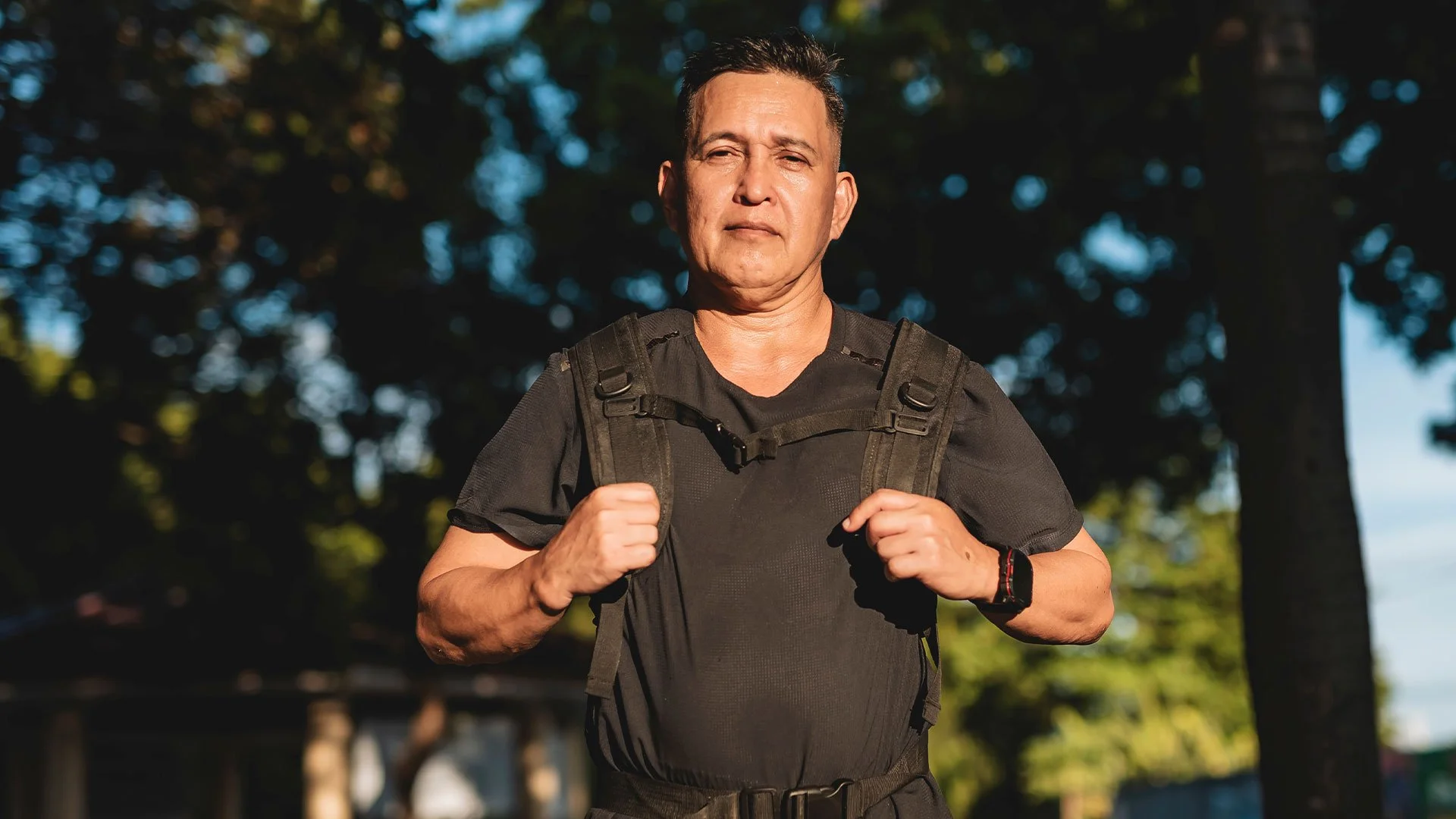
Rucking, the practice of walking with a weighted pack on your back, started as a staple of military training. Soldiers have marched under load for centuries to build endurance, mental toughness, and the kind of full-body resilience that keeps you operational under pressure. U.S. Special Forces candidates still carry 45-pound packs over 12-mile courses as part of selection. It is one of the most straightforward tests of physical readiness in the military.
Now the movement has crossed into the civilian fitness world and it is growing fast. According to National Geographic reporting, GoRuck, founded by former Army Special Forces member Jason McCarthy, saw significant year-over-year sales growth from 2023 to 2024, and Google searches for rucking have climbed steadily over the past decade. A book dedicated entirely to the practice, Walk With Weight by Michael Easter, was featured on NPR in February 2026. Walking with weight is no longer a niche military exercise. It is becoming one of the most popular fitness trends of the year.
The reason is practical. Rucking combines cardiovascular conditioning and resistance training in a single activity. The added weight forces your posterior chain, glutes, hamstrings, core, and back to work constantly to keep you upright and moving forward. A study published in the Journal of Strength and Conditioning Research found that a 10-week load-carriage conditioning program produced significant improvements in estimated maximal oxygen uptake (VO2 max) alongside increases in lower-body power and muscular endurance (Wills et al., 2019). You are building strength and endurance at the same time, without running and without a gym membership.
Rucking also keeps your heart rate in the aerobic zone 2 range, the intensity level associated with building endurance, improving metabolic health, and supporting long-term cardiovascular function. Unlike running, which generates ground reaction forces of 2.5 to 3 times your body weight with every stride, rucking keeps one foot on the ground at all times. That means serious cardiovascular benefit with significantly less joint stress.
The mental health component matters too. The rhythmic, repetitive nature of loaded walking allows the mind to settle. Veterans and military communities have increasingly adopted rucking as a structured mental health practice, and research on outdoor movement consistently shows reductions in cortisol and improvements in mood.
How to start: You don’t need specialized gear. A sturdy backpack with padded straps is enough. Start with 10 to 20 pounds and walk for 20 to 30 minutes on flat terrain. Aim for a pace of about 15 minutes per mile. If you’re moving slower than 20 minutes per mile, reduce the weight. Ruck once or twice a week at first, and build from there.
Form matters: the pack should sit high on your back, close to your body, not hanging low. This is functional fitness in its simplest form. No screens. No subscriptions. No complicated programming. Just you, some weight, and the decision to move.
Bottom line: Rucking is one of the simplest ways to build strength, endurance, and mental clarity without a gym. It started in the military. It works for everyday athletes. If you can walk and you own a backpack, you already have everything you need.
Wills, J. A., Saxby, D. J., Glassbrook, D. J., & Doyle, T. L. A. (2019). Load-carriage conditioning elicits task-specific physical and psychophysical improvements in males. Journal of Strength and Conditioning Research, 33(9), 2338-2343. https://doi.org/10.1519/JSC.0000000000003243
Your Body Is Not Canceling Out Your Workout
There is an idea that has floated around exercise science for years: the more active you are, the more your body compensates by burning fewer calories elsewhere. Under this model, moving more does not necessarily mean burning more because the body quietly redirects energy from other processes to "pay for" the activity. It is a discouraging theory if true. It would mean your effort has a ceiling.
A study published in the Proceedings of the National Academy of Sciences challenges that idea directly.
Researchers at Virginia Tech, working with colleagues from the University of Aberdeen and Shenzhen University, measured total daily energy expenditure in 75 participants ranging in age from 19 to 63. Activity levels spanned from largely sedentary lifestyles to ultra-endurance running. To measure energy use, participants drank isotopically labeled water containing traceable forms of oxygen and hydrogen and provided urine samples over a two-week period. By comparing how each isotope left the body, researchers could calculate carbon dioxide production and, from that, total calories burned. Physical activity was tracked using a waist-worn accelerometer (Howard et al., 2025).
The results were clear. As people moved more, their total energy expenditure increased accordingly. Essential functions like breathing, blood circulation, and temperature regulation continued to require the same amount of energy regardless of activity level. The body did not appear to compensate by dialing down energy use elsewhere.
This matters because the alternative theory, sometimes called the constrained energy model, has gained traction in recent years and has been used to argue that exercise is not particularly effective for weight management. This study, using the gold-standard method for measuring energy expenditure in free-living humans, found no evidence of that constraint in adequately fueled individuals.
The researchers noted an important caveat. Under extreme conditions where individuals are not consuming enough calories, some apparent compensation could reflect under-fueling rather than a true biological ceiling. That distinction matters. It means the body is not working against you. It means the work counts.
For everyday athletes, the takeaway is straightforward. Consistent movement adds up. It does not get erased by some hidden metabolic adjustment. What you do in a training session contributes directly to your total energy output for the day.
Bottom line: Your body is not quietly undoing your effort. More movement means more energy burned. The constrained energy theory does not hold up in well-fueled, active people. Consistent training matters, and the science now confirms that the return on your effort is real.
Howard, K. R., Prado-Novoa, O., Zorrilla-Revilla, G., Laskaridou, E., Reid, G. R., Marinik, E. L., Stamatiou, M., Hambly, C., Davy, B. M., Speakman, J. R., & Davy, K. P. (2025). Physical activity is directly associated with total energy expenditure without evidence of constraint or compensation. Proceedings of the National Academy of Sciences, 122(43). https://doi.org/10.1073/pnas.2519626122
12 Weeks of Exercise Reversed Biological Aging by 10 Months
Aging happens to everyone. But the rate at which your body ages is not fixed.
Researchers have increasingly turned to blood-based protein signatures to measure biological age, which can differ meaningfully from the number on your birth certificate. These proteomic aging clocks analyze hundreds of circulating proteins to estimate how old your body actually functions, not just how many years you have been alive.
A study published in npj Aging used data from 45,438 participants in the UK Biobank to examine the relationship between physical activity, proteomic aging, and disease risk. The researchers found that a higher proteomic aging score was associated with lower physical activity levels and increased risk of type 2 diabetes and ischemic heart disease. In other words, the people aging fastest biologically were also the least active (Lee-Odegard et al., 2026).
But the study went further. In a separate 12-week supervised intervention involving 26 men, the researchers measured proteomic age before and after a structured program combining endurance and strength training. After 12 weeks, the participants' proteomic aging score decreased by the equivalent of 10 months. Their blood protein profiles shifted in a direction consistent with younger biological function.
Out of the 204 proteins used to calculate the aging score, most remained stable. But specific proteins, notably one called CLEC14A, changed measurably with exercise and were linked to improvements in insulin sensitivity. Transcriptomic data from muscle and fat tissue supported these protein-level changes, pointing to pathways involved in tissue remodeling and metabolism.
This is not about reversing wrinkles or turning back the clock in some superficial sense. It is about internal function. The proteins circulating in your blood reflect how well your body manages inflammation, repairs tissue, regulates glucose, and adapts to stress. Exercise appears to shift that entire profile toward younger, more resilient function.
The study's sample size for the intervention was small, and the researchers acknowledge that proteomic aging is mostly stable. But even modest reversal through a structured 12-week program suggests that the biological impact of consistent training extends far deeper than what is visible.
Bottom line: Your body's biological age is not locked in by the calendar. Consistent exercise changes how your body functions at the protein level, shifting the markers of aging in the right direction. The 12 weeks you invest today may be worth more than 10 months of biological time.
Lee-Odegard, S., Austin Argentieri, M., Norheim, F., Drevon, C. A., & Birkeland, K. I. (2026). Reversal of proteomic aging with exercise: Results from the UK Biobank and a 12-week intervention study. npj Aging, 12, 19. https://doi.org/10.1038/s41514-025-00318-w
About The FitNKC Health Report
Every month, we examine recent peer-reviewed research and online articles to share what we are learning about health, fitness, and wellness. No co-signing trendy supplements. No fear-mongering about training methods. Just an honest take on stories and advancements in health and wellness.
Have a Story We Should Cover?
Found a study that challenges conventional wisdom or confirms what actually works? Came across an article that made you think twice? We are always looking for research and stories worth sharing. Submit your suggestions using the link below.
Disclaimer: Featuring a study or topic in this report does not constitute endorsement, support, or recommendation of any particular product, method, claim, or course of action. The FitNKC Health Report covers advancements and developments in the health and fitness space strictly for commentary and discovery purposes. This content should not be construed as medical, nutritional, or professional advice, nor as factual claims or guidance. FitNKC is not prescribing, diagnosing, promoting, or advising any course of action; we are simply sharing what we find relevant or interesting in our field. This Health Report exists under fair use for purposes of commentary, criticism, and analysis. Readers should consult qualified professionals before making changes to their health, fitness, or nutrition practices. If you are an author, researcher, publisher, or rights holder of any content referenced in this report and would like to request updates, modifications, or removal, please contact us directly at this link. FitNKC is committed to accuracy, proper attribution, and respect for intellectual property.